

I wrote a book. Again.
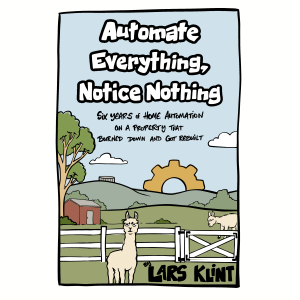
It’s called Automate Everything, Notice Nothing, and it’s about six years of automating this farm — water tanks, gates, heating, cameras, networks — and mostly about the parts that didn’t work.
It’s out now as an ebook and print-on-demand paperback.
The sentence the whole thing came from
In 2020 I complained to a friend about walking up a hill in the dark to look into a water tank. I’d done it hundreds of times. Torch, boots, uphill, look in the hole, walk back down, and repeat in three days when I stopped being sure again.
He answered with five words: pressure sensor, ESP32, Home Assistant.
That was it. That’s the whole origin. Everything on this property since — every sensor, every automation, every trench I’ve dug and every cable I’ve got wrong — traces back to somebody answering a complaint with a specific suggestion instead of sympathy.
The first chapter is about that tank. The last one is about a house that doesn’t exist yet.
What it’s actually about
The argument runs underneath every chapter and it’s this: the best automation is the kind nobody notices.
Not the impressive kind. Not the kind you demo to visitors. The kind where a thing you used to think about every few days quietly stops needing to be thought about, and eighteen months later you realise you’ve forgotten it exists.
Fiona has never opened Home Assistant. Not once in six years. That isn’t a failure of the system — that’s the specification. Her interface is a light switch that works, a warm bathroom, and a gate that’s already moving when she comes up the drive. If she ever has to learn how any of it works, I’ve done it wrong.
So the successes in this book are all invisible. Which makes for a strange thing to write about, and is why the book is mostly about the failures instead. Those are considerably funnier.
Some of the failures
There’s the night I automated the bore pump and it ran until morning, turning the paddock into a swamp for days.
There’s the guest in our cottage who climbed a wall to tape over the aircon sensor, because I’d built an automation against people’s behaviour instead of for it.
There’s the access point I mounted on the apex of the power shed with Tarzan’s Grip, which held perfectly for exactly three weeks before autumn thermal cycling had its say.
There’s the UPS video where I confidently explained my runtime calculations, having read 1800 watts as a quantity of stored energy rather than a rate limit. Someone corrected me in the comments. He was right, and I pinned it.
And there’s the gate, which I have now rebuilt so many times that my own video titles started saying “again”.
Every chapter has a section called What it cost me. A book of things that worked would be both dishonest and useless.
The ninth of January
On the 9th of January 2026 a bushfire came through this property.
It took four buildings, eight cars — six of them in the one shed — and a lifetime of collected things. I watched it from a motel room in Melbourne, on the cameras, until the power went and there was nothing to watch.
There’s one chapter about that afternoon. It’s the shortest one in the book. For about an hour everything worked perfectly: the sensors reported like it was any other day, the smoke alarms went off one after another exactly as designed, and then devices began dropping offline one at a time as the fire crossed the property. I could follow it by which things had stopped answering.
Then at about half past four the power went and the rest disappeared at once.
Five days later we came back with a generator and the system woke up, found the devices that still answered, and turned the lights on at six o’clock as though nothing had happened.
Automation has no model of catastrophe. It only has a model of absent devices.
The book has a chapter about that, and then it moves on. The fire is the hardest part of this story but it isn’t what the story is about. What it’s about is the ordinary business of making a place work.
Who it’s for
It’s a journal, not a manual. Fourteen chapters, roughly in order from 2020 to now, written so you can read it straight through even if you never intend to automate anything.
If you are here for the technical detail, it’s all there — but it’s quarantined into boxed sections called Deeper Cut, which you can skip entirely without losing the thread. Pressure sensors and why vented ones matter. Radio protocol choice and why my mailbox sensor was doomed from the start. Addressing schemes that survive growth. Backup strategies that survive your own laziness.
Read only those and you’d have a patchy reference book. Skip them all and you’d still have the whole story.
The drawings
David Neal illustrated it — he did my Manning book too, and he somehow draws the joke I was trying to make rather than the one I actually made.
There are fifteen of them, one per chapter, plus the cover. There are llamas hidden in some of them. That’s deliberate, and if you’ve watched the channel for any length of time you’ll know why.
Where to get it
The ebook is available now — EPUB and PDF, $9.95. The paperback is a proper 6×9, 158 pages, with all the illustrations, and it’s coming shortly.
It’s free for channel members. No catch and no discount code — it’s yours, and there’s a members post with the download.
That’s not generosity, it’s arithmetic. A large part of this book came out of six years of comments correcting my maths, catching my wrong cable, and suggesting better approaches than the ones I’d found on my own. It didn’t feel right to charge the people who supplied half the material.
Published under my own imprint, Woolshed Press — named after the building that housed my office until January.